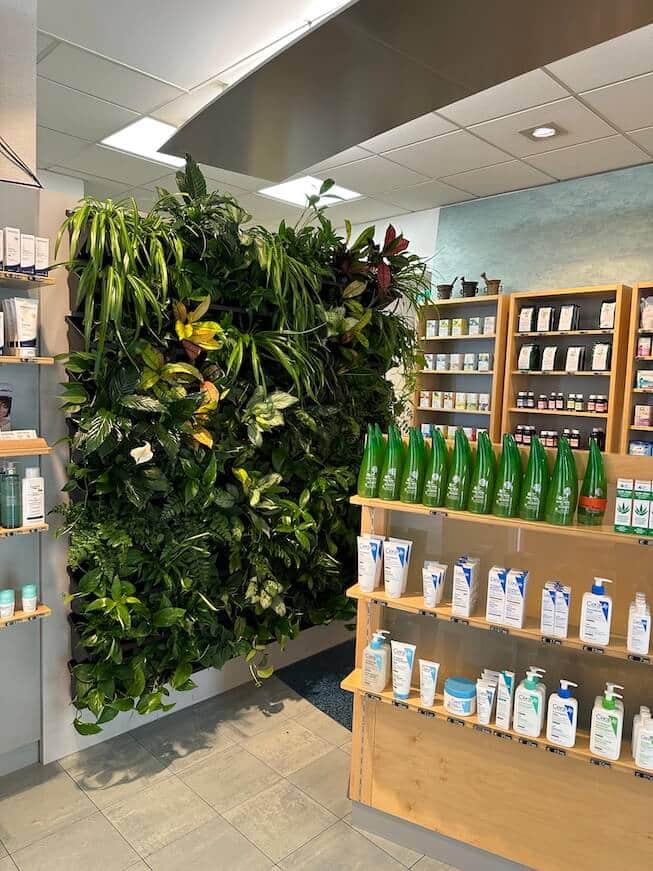
Interior greening
Plant lovers, beware! Our Vertical interior greening, with a wide variety of houseplants, offers many advantages, including improved indoor climate and aesthetic value.

Interior greening
Hydroponics and indoor plants influence the indoor climate in offices and living spaces, but also in pharmacies. As indoor plants in soil substrates are not permitted due to possible mould growth, indoor greenery with hydroponics is a very good alternative.
Indoor greenery with houseplants is recommended by many doctors. According to studies, the bacterial load indoors is highest without indoor plants. If hydroponics is used, mould cannot form as the surface of the hydrosubstrate (e.g. expanded clay, Lechuza) is always dry and free of organic matter. Mould fungi and other microorganisms do not have a breeding ground to develop and form spores.
But what exactly is the effect of hydroponics or green plants? We asked the company Hiebinger Hydroponics, which also realised our interior greening.
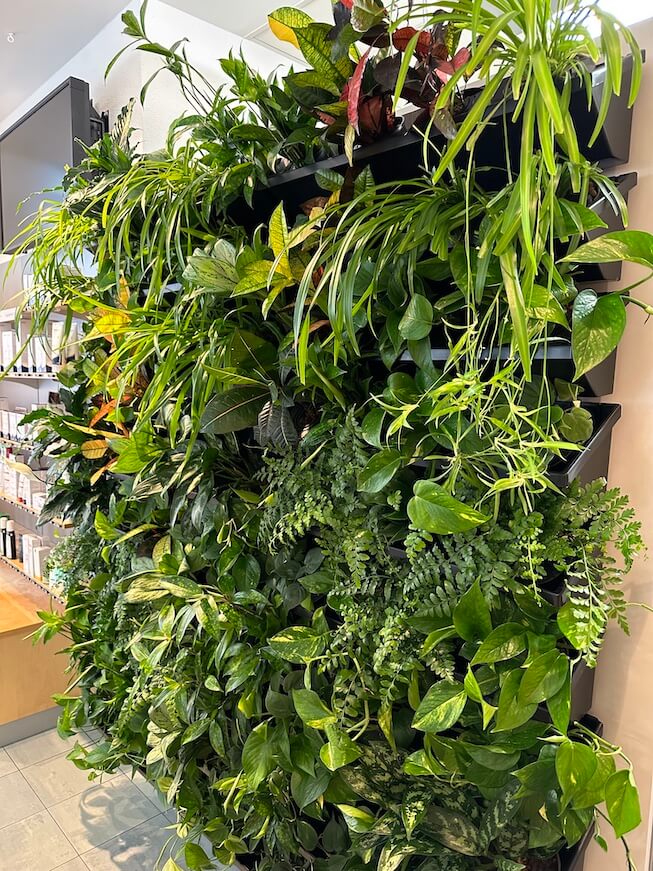
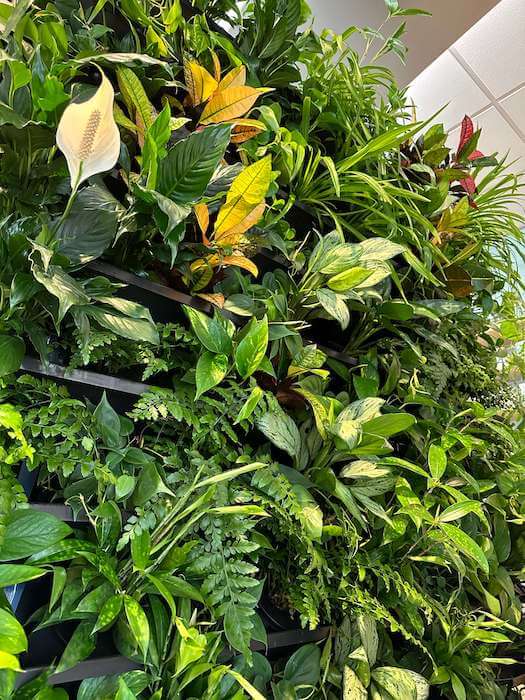
Health factor “psychology”
Many scientific studies around the world have shown that houseplants are an essential feel-good factor and that people enjoy being around them. Indoor plants also purify the air indoors, provide privacy and can reduce noise.
The humidity indoors is usually too low for humans. Depending on the size of the room, the type of plant and the number of plants, the humidity can be increased by approx. 2-3 %.
Studies have shown that indoor greenery can reduce illnesses such as eye irritation, conjunctivitis, skin irritation, colds and respiratory tract irritation. Sick days in offices are also reduced by 1 to 3.6 sick days.
In addition, green indoor spaces are often perceived by their users as more attractive, more natural, more relaxed, more conducive to concentration, more humid, more refreshing, more surrounded by nature and more humane. It has been shown that indoor greenery can improve and stabilise people's mental well-being. Depression, anxiety and anger can be reduced.
Humidity as a health factor“
Mucous membranes
Studies show that too little humidity slows down and impairs the functions of the mucous membranes. This can increase the risk of illness. The optimum self-cleaning function is achieved at a humidity of approx. 45 %.
Particulate matter and flu viruses
The shortest lifespan of virus particles is between 50 and 80 % relative humidity. If the humidity is too low, aerosols from the exhaled droplets evaporate more quickly and the droplet core is released. This increases the likelihood of pathogens being transmitted. Higher humidity in the room means that exhaled droplets absorb more water and sink to the floor more quickly due to their greater weight.
Hoarseness and laryngitis
The mucous membranes of the vocal folds also need sufficient humidity. The air supply causes them to vibrate. If the humidity is too low, they lose their elasticity and the person begins to clear their throat, cough or swallow.
Dry eyes
Working too long in front of a screen or draughts can cause swelling, redness, foreign body sensation, sensitivity to light and burning. If the humidity is too low, the tear fluid begins to evaporate. This risk can be avoided if the humidity indoors is between 40 and 60 %.
Plants can be used to increase the humidity indoors in a safe way. Houseplants evaporate approx. 90 % of the water they are watered with and release it into their surroundings. They are a more tolerable alternative to aerosols from air conditioning systems. Modern plant substrates such as hydroponics rule out side effects such as phatogenic germs and allergies.
Hydroponics is the best choice and is recommended by doctors!